 Solo monologue
Lifeboat Six
1 performer. 20 minutes.
Solo monologue
Lifeboat Six
1 performer. 20 minutes.
At a fundraiser after the Titanic disaster, Margaret Tobin Brown tells the story of Lifeboat Six without the legend that later swallowed her. Fear,…
Read the playAn hour after a performance, a single afternoon in a studio, a week with a company, or a term built around a play your students are reading. Jeanmarie has worked this way since her first school residency at twenty four, in person and online.
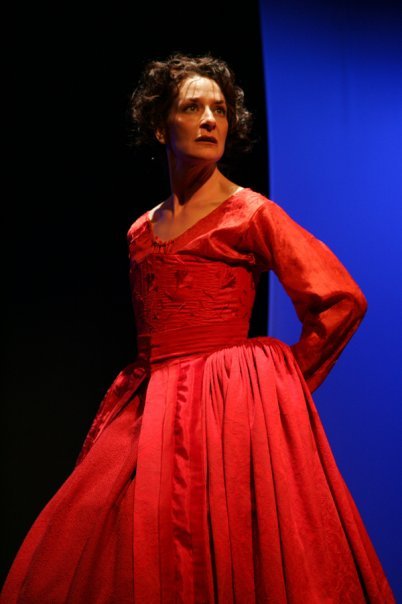
A talkback after a performance, or a visit to a seminar reading one of the plays. Questions from the room, answered by the person who wrote it.
One subject taken seriously: audition technique, playing a solo piece, staging with nothing, or writing from testimony.
A group works one text from first reading to a showing, with the technique taught as the need for it arises.
She becomes part of the building, teaching daily, making an original piece or an adaptation with the group, and leaving a performance behind.
Your actors read a play aloud, she listens, and the afternoon becomes a conversation about what the text is doing and why.
The work scales down as readily as it scales up. A class of eleven year olds and a graduate conservatoire get the same attention, in different language.
01
A conversation first
What you are studying, how many people are in the room, and what you would like to exist at the end of it.
02
Material chosen
An existing play, an adaptation, or an original piece built from what the group brings in.
03
Daily work
Sessions on their feet, with technique introduced at the moment the group needs it rather than in advance.
04
Something shown
A showing, a staged reading, or a full performance, staged with whatever the building already owns.
In person is better for contact work, for ensemble building and for anything that ends in a performance. Online is genuinely good for text work, for audition coaching and for guest discussions, and it removes travel from the budget entirely.
Through Arizona Theatre Matters and Universal Access Productions she has spent years making theatre in digital spaces, so an online session is a considered format rather than a compromise.
The high school students from her first residency, taught when she was twenty four, are now over forty.On residencies
There is no rate card. Every engagement is quoted on its own terms and scaled to the organisation asking.
Answer what you can. A rough budget range and an approximate date are far more useful than a perfect description, and she will reply herself.
Residencies work best when the group has already read something. These three suit a short visit, a scene unit and a full staging respectively.
Solo monologue
Lifeboat Six
1 performer. 20 minutes.
At a fundraiser after the Titanic disaster, Margaret Tobin Brown tells the story of Lifeboat Six without the legend that later swallowed her. Fear,…
Read the playClara Barton looks back across the wounds that shaped her life, from a brother’s childhood accident and Civil War battlefields to the Missing Soldiers…
Read the playShakespeare’s dead are not finished with one another. In Purgatory, Hamlet, Ophelia, Gertrude, Claudius, Polonius, Laertes, Rosencrantz, Guildenstern, and the old king must climb…
In the collection Read the playI met Jeanmarie when I was about 13 years old when she was an Artist in Residence at my school in Virginia City, Nevada. She was incredibly patient with us rowdy teenagers and never failed to show compassion towards each of us.Amber Noelle Burg
Jeanmarie’s work with my son changed his life for the better. His disability made him a target for bullying. She gave him opportunities to interact with his classmates in ways he never had before.Jeff Osten
A short letter when a play is finished, when a production opens, or when new classroom material becomes available. Nothing else.